
S10U TRENDLINE
WhatsApp Commerce Is Here: How SA Brands Are Selling Inside the Chat
South Africa has one of the world’s highest WhatsApp penetration rates — and its brands are turning that dominance into direct revenue. Here is what the WhatsApp-native sales funnel looks like, who is already using it, and why the window to act is now.
- 18 March 2026
- Category: Digital Commerce & WhatsApp
- Author: Willie Swart
- willie@s10u.co.za
The Shop Has Moved Into the Chat
The statistic is hard to ignore: 93.8% of South Africa’s internet users are on WhatsApp — roughly 29 million people. South Africans spend an average of nearly 25 hours a month on the platform, placing SA fifth globally for WhatsApp usage time. Your customers are already there. The question is whether your business is meeting them in the channel they have already chosen.
For years, ‘digital marketing’ meant driving traffic to a website. That funnel — ad click, landing page, form fill, email nurture, eventual sale — was built for desktop users with time to browse. It was never designed for a market where most people shop on a smartphone, where data costs make website navigation a friction point, and where WhatsApp messages achieve a 98% open rate versus email’s true open rate of 20–25%.
South Africa’s conversational commerce transaction value is projected to grow from US$1.3 billion in 2023 to US$2.9 billion by 2028. That growth is not being driven by new technology. It is being driven by brands that recognised WhatsApp as the commerce channel it already was — and built their sales journeys accordingly.
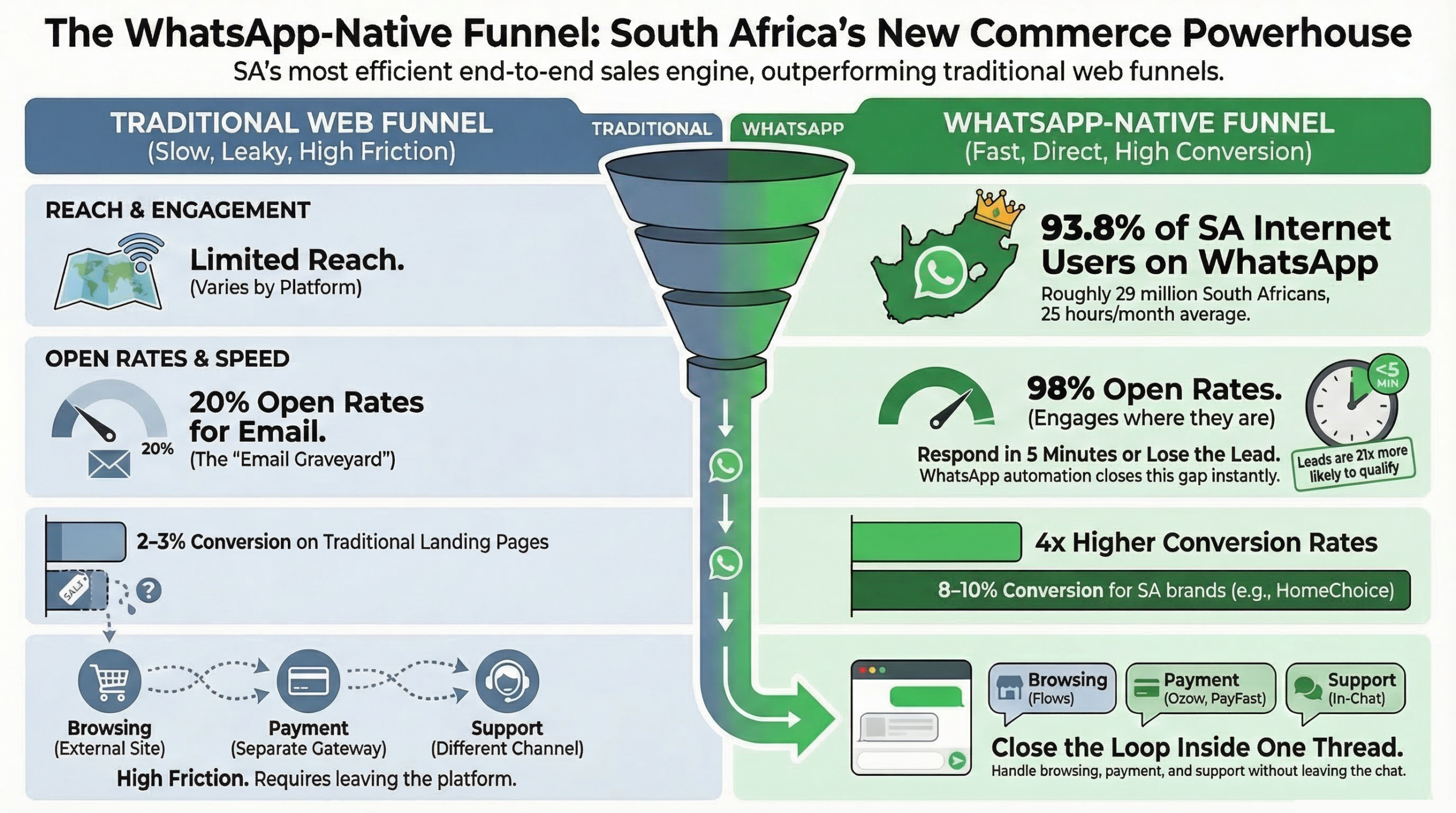
From Ad Click to Payment in a Single Thread
A WhatsApp-native sales funnel does not replace your marketing. It compresses it.
Stage 1: Entry via click-to-WhatsApp ads
A click-to-WhatsApp ad on Facebook or Instagram drops a customer directly into a conversation — no landing page, no form, no website required. Meta classifies these as free entry-point conversations for 72 hours after first contact. The customer’s number is captured automatically the moment they message. Stone, a Brazilian fintech, reported a 5x lower cost per acquisition compared with other digital campaigns using this approach; Arabian Automobiles achieved double the leads at 56% lower cost-per-lead.
Stage 2: Qualification inside the conversation
A WhatsApp Business API chatbot sends a welcome message and presents quick-reply options — browse a catalogue, request a quote, book an appointment, or speak to an agent. Qualification questions capture the data that would normally require a web form: budget, location, intent, time frame. All collected conversationally, on the channel the customer is already using.
Stage 3: Consideration without leaving WhatsApp
WhatsApp Flows allow structured multi-step experiences — dropdown menus, product comparisons, document requests — without the customer opening a browser. Product catalogues display up to 500 items with images, descriptions, and pricing. Kings Wear embedded WhatsApp Flows for browsing through to checkout and achieved a 4x increase in online sales. For higher-value products, a personalised proposal arrives as a structured message in the same thread.
Stage 4: Payment inside the conversation
WhatsApp Pay is not yet available in South Africa, but the market has built robust alternatives. Payment links from Ozow, Peach Payments, and PayFast open a secure checkout that returns customers to the WhatsApp thread after completing the transaction. Clickatell’s Chat 2 Pay embeds this directly inside the chat. The full purchase loop — selection, payment, confirmation — happens without the customer ever visiting a website.
Stage 5: Post-sale in the same thread
Order confirmations, delivery tracking, renewal reminders, service notifications, and restock alerts all live in the same conversation. The customer does not need to manage a new account, recall an email thread, or navigate a self-service portal. The full relationship exists where they already spend their time.
SA Brands Are Already There
This is not a future scenario. South African businesses across retail, insurance, and financial services are running complete sales cycles on WhatsApp today.
HomeChoice, the 40-year-old SA retail and financial services brand, has built what it describes as a “full sales and customer experience engine” on WhatsApp. Their click-to-WhatsApp ads achieve 8–10% conversion rates — four times the typical 2–3% for traditional landing pages — while call volumes dropped by 35% as customers migrated to chat.
Guardrisk’s CarSure product uses a WhatsApp chatbot to sell excess buy-down insurance to car renters: prospects enter via WhatsApp, answer qualifying questions, receive a quote, and complete the purchase — entirely within the chat experience. MiWay Blink launched a WhatsApp chatbot for car insurance quotes in early 2024, eliminating phone queues and wait times entirely.
Prepaid24, working with Chat Inc and Ozow, enables South Africans to purchase prepaid electricity within a WhatsApp conversation — from product selection to payment to voucher delivery, without opening a single website. Co-founder Ben Lindeque describes the platform as tackling “the dual challenges of digital exclusion and electricity access in South Africa.” The commerce mechanism and the social purpose are the same thing.
Nedbank, Absa, Old Mutual, and Telkom SA are processing everything from peer-to-peer payments to policy applications and product sign-ups inside WhatsApp. According to the World Wide Worx Online Retail Report 2025, 69.2% of SA retailers now use WhatsApp for customer support, 51.2% for promotions, and 35.8% for direct sales. The technology is proven. The behaviour is established. What varies is how far each brand takes it.
“Chat commerce is on track to overtake traditional e-commerce.”
Richard Eberlein, Managing Executive for Customer & Growth at HomeChoice
What the Technology Actually Requires
Running a WhatsApp-native sales funnel is not technically complex — but it does require the right components working together.
- WhatsApp Business Platform access via an official Business Solution Provider (BSP) is the foundation. In South Africa, established BSPs include Clickatell (which counts MTN, Absa, Dis-Chem, and Telkom among its clients). The BSP layer handles high-volume messaging, verified business profiles, and template compliance. S10U AI Studio connects directly to the WhatsApp Business Platform, integrating WhatsApp with email, SMS, and voice inside a single managed solution.
- Automation and conversation design determine how customers experience the funnel. WhatsApp Flows handle structured interactions. AI-assisted conversations qualify and route leads. The human-to-bot handoff needs to be designed deliberately, not patched in as an afterthought.
- CRM integration ties every WhatsApp conversation to a customer record. S10U has its own CRM platform, which can be deployed as part of the full solution. Where clients operate existing systems, S10U AI Studio also integrates with third-party CRMs including HubSpot, Salesforce, and Zoho — enabling automated deal-stage updates, lead scoring, and personalised outreach based on existing customer data.
- Payment integration closes the loop. SA-specific options — Ozow, Peach Payments, PayFast — embed naturally into the conversation without requiring customers to navigate to a separate website.
Traditional Funnel vs. WhatsApp-Native: The Real Difference
The traditional SA digital funnel loses customers at every transition. Average landing page conversion sits below 4%. Cart abandonment runs at 70%. The average lead response time across industries is 42 hours — and 63% of businesses never respond at all.
A WhatsApp-native funnel eliminates the transitions. Here is what that looks like in practice:
|
|
Traditional Funnel
|
WhatsApp-Native Funnel
|
|---|---|---|
Research from InsideSales/Velocify shows that responding to a lead within one minute increases conversions by 391%. Within five minutes, leads are 21x more likely to qualify than at 30 minutes. WhatsApp — with messages read under five minutes and bot-enabled instant responses — structurally eliminates the response-time gap that kills traditional funnels.
The POPIA Angle Most Businesses Are Missing
POPIA’s Section 69 imposes strict opt-in requirements for electronic direct marketing in South Africa — requirements most businesses treat as a compliance obstacle. The WhatsApp Business API’s architecture actually makes POPIA compliance more achievable, not less.
The platform’s built-in opt-in enforcement and template approval process align naturally with POPIA’s consent-by-design requirements. Every marketing message sent outside the service window requires a pre-approved template. Every interaction requires the customer to initiate or explicitly agree. For SA businesses in insurance, financial services, and healthcare — where POPIA compliance is both critical and closely scrutinised — WhatsApp Business API is not a regulatory risk. It is a more defensible channel than most of the alternatives.
Where S10U Fits In
S10U AI Studio is S10U’s own enterprise WhatsApp capability — combining the WhatsApp Business Platform, automation flows, AI-assisted conversations, S10U’s own CRM platform, and broadcast campaigns inside a single managed solution. All customer data is stored on South African-based AWS infrastructure in the Cape Town region, addressing data residency requirements for POPIA compliance from day one.
For SA brands in retail, automotive, insurance, and financial services, S10U builds the complete orchestration layer: BSP access, conversation design, payment integration, CRM connectivity, and the analytics to measure every step of the journey from first message to closed sale.
WhatsApp is not an add-on to your digital strategy. For most South African businesses in 2026, it is where your customers already are — and where your sales funnel should already be running. The brands building WhatsApp-native funnels now are not early adopters. They are on time.
Ready to build your WhatsApp-native sales funnel?
S10U offers a focused WhatsApp strategy session — a practical conversation about your business model, current channels, and where a WhatsApp-native funnel will move the needle. No jargon. No generic playbooks. Just a clear view of what is achievable for your specific business.
- Author: Willie Swart | willie@s10u.co.za | Sideways10UP
Published 18 March 2026 — third week of March, as specified in the S10U Trendline 2026 Content Strategy. All statistics are sourced from research available by this date: Ozow Conversational Commerce Report 2025, World Wide Worx Online Retail Report 2025, Meltwater SA Digital Report 2025, and Statista/Hubtype SA WhatsApp penetration data. HomeChoice, Guardrisk CarSure, MiWay Blink, and Prepaid24 case studies are all publicly documented. The conversational commerce growth projection (US$1.3B → US$2.9B by 2028) is sourced from Ozow and corroborated by Hubtype research. The article reads naturally as a March 2026 thought leadership piece — the ‘year of execution’ framing is consistent with industry consensus at this date and directly connects to the February 2026 AI Agents article published earlier in the quarter.

Let us Bring your Ideas to Life in the Digital World.
No matter which services you choose, we are committed to delivering exceptional results that exceed your expectations. Our multidisciplinary team works closely together to ensure seamless collaboration and a unified vision for your digital product.