
S10U TRENDLINE
The Hidden Cost of Fragmented Tools: And How SA Businesses Are Finally Fixing It
Most South African businesses know exactly what they pay for each tool in their stack. Almost none know what it costs them to run all those tools separately. The invoice is the visible part. The missed leads, the manual reconciliation, the data that never gets used — that is the bill that never arrives. Here is what that actually adds up to, and what the fix looks like in practice.
- 27 April 2026
- Category: Digital Strategy & Operations
- Author: Willie Swart
- willie@s10u.co.za
How many tabs do you have open right now?
Be honest. There is a CRM tab. An email marketing tab. A WhatsApp Web tab that has not been refreshed since yesterday. A social scheduling tool. A Google Sheet that somebody in the team swears is the single source of truth. An analytics dashboard. And somewhere behind all of that, the actual work you were supposed to be doing.
This is not a productivity problem. It is a structural one.
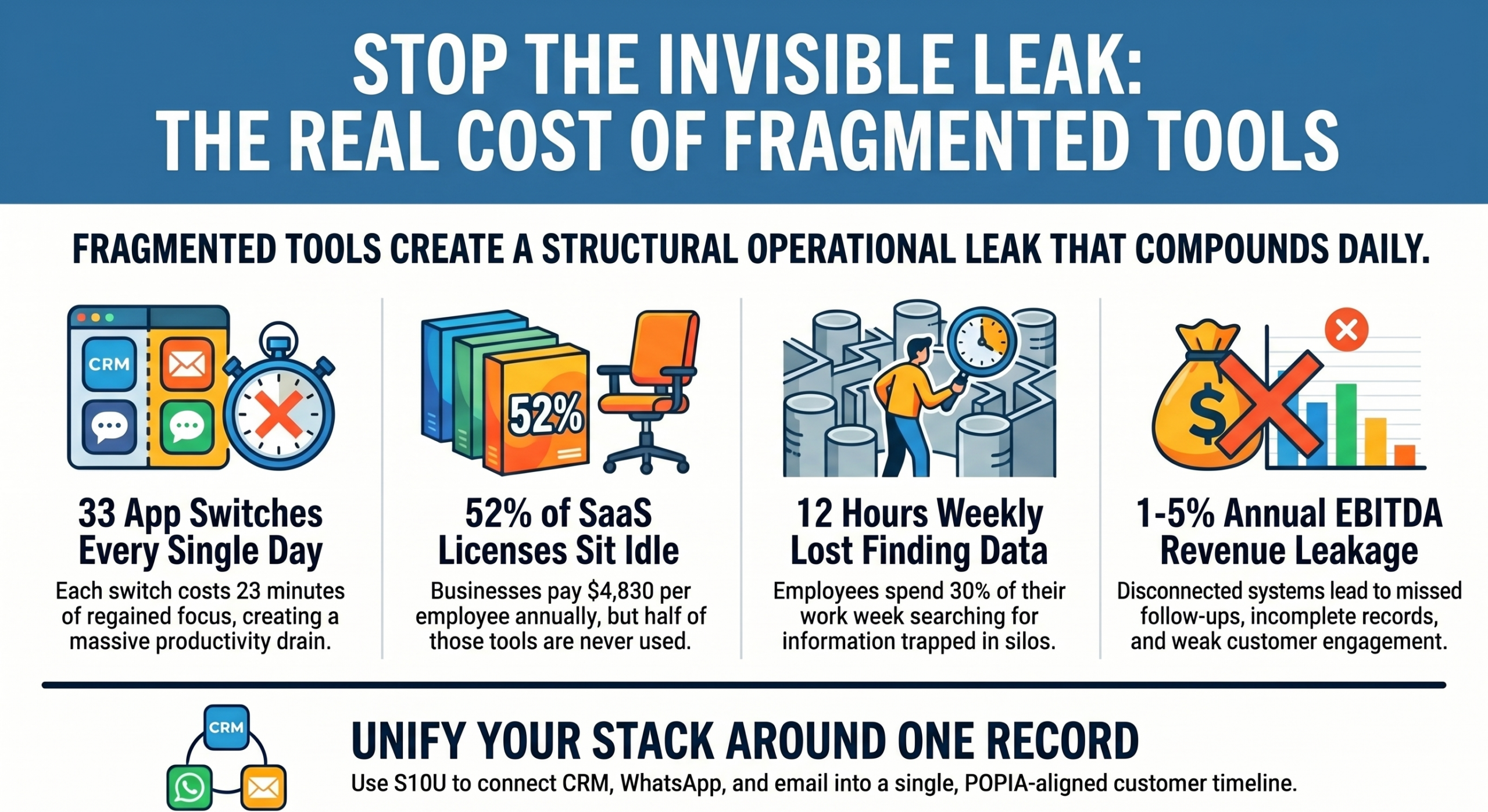
Research from Deloitte shows workers switch between apps or platforms an average of 33 times per day — with 17% switching more than 100 times daily. Each switch costs around 23 minutes of regained focus. Across a team, that is not tool fatigue. That is a significant operational leak, and it compounds quietly every single day.
For a mid-size South African business running six to ten disconnected tools, the cost does not show up on any single invoice. It shows up in the leads that went cold, the report that took three hours to compile, and the follow-up that never happened because nobody could find the original conversation.
The real price of a fragmented stack
The subscription line is the smallest part of the problem.
According to the Zylo 2025 SaaS Management Index, the average SaaS spend per employee now sits at $4,830 per year — up almost 22% year-on-year. And 52.7% of those licences sit completely idle. A Productiv analysis of nearly 100 million SaaS licences found that 40% were never used at all. Businesses are not just paying for tools. They are paying for tools that nobody opens.
Then there is the data problem. Research from DATAVERSITY’s 2024 Trends in Data Management Survey found that 68% of businesses cite data silos as their single biggest data management concern — up seven percentage points from the year before. Forrester puts the human cost at 12 hours per week per employee, spent just looking for information trapped across disconnected systems. That is 30% of a working week, gone.
The revenue leakage is harder to see but arguably more damaging. EY research indicates companies lose between 1% and 5% of EBITDA annually from missed follow-ups, incomplete CRM records, and weak post-sale engagement. The root cause, consistently, is the same: systems that do not talk to each other.
“Your team should not be the integration layer. When they are copying data between systems and manually reconciling reports, they are doing the job the technology was supposed to do.”
Why this hits SA businesses harder
South Africa’s mid-market has a structural problem that makes fragmentation particularly expensive. Skills shortages, the cost of imported SaaS licences, and POPIA compliance requirements all add friction to the integration challenge that businesses elsewhere do not face at the same intensity.
Then there is WhatsApp. Over 90% of South Africans use WhatsApp daily, making it the dominant first-contact channel for consumer-to-business interaction — well ahead of email and social media for actual conversation. A 2025 SciELO/UNISA study confirmed that WhatsApp Business is the primary digital engagement tool for South African small and micro-retailers.
Yet for most mid-size SA businesses, WhatsApp operates in complete isolation. A customer messages in. Someone replies. The conversation ends. Was it logged in the CRM? Was there a follow-up sequence? Did the email platform know about it? Almost certainly not, because nothing is connected.
When a lead comes in on WhatsApp, gets followed up by email, and is then discussed in a team chat — there is no single place that holds the full story. The customer experience is fragmented because the business stack is fragmented. That is not a communication problem. It is a systems architecture problem.
What a unified digital stack actually looks like
A unified digital stack is not one product that tries to do everything badly. It is a set of tools deliberately built to share a single customer record, trigger each other automatically, and report into one view.
When it works, the change is concrete:
1. A lead fills in a form on your website. They are created in the CRM, assigned to a sales rep, and sent an automated WhatsApp acknowledgement — inside sixty seconds, without anyone touching a keyboard.
2. A deal closes in the CRM. That contact is automatically removed from the prospect nurture sequence and added to the onboarding communication list. No CSV export. No manual update.
3. Every WhatsApp message, email, social DM, and call note sits on one timeline against one contact record — not spread across five inboxes that nobody ever cross-references.
4. Reporting is one dashboard, not a Monday morning ritual involving seven tabs and a Google Sheet that someone has to build by hand.
HubSpot’s own research found that organisations using multiple connected messaging channels cut response times by more than a third and saw measurable gains in customer satisfaction. The mechanism is not mystery — it is just visibility. When the information flows to where it needs to be, the team can actually act on it.
The fix that is gaining ground
The market for integration solutions is growing at a pace that reflects how serious the problem has become. The iPaaS (Integration Platform as a Service) sector was valued at $12.87 billion in 2024 and is projected to reach $78.28 billion by 2032 — a compound annual growth rate of almost 26%. More than half of small and mid-size businesses (53.6%) now rely on some form of integration tooling to connect their systems.
But plugging tools together with third-party connectors is not the same as running an integrated stack by design. Connectors break. They require maintenance. They add another vendor to manage. And for SA businesses navigating POPIA compliance, customer data cannot move between systems without proper governance — a requirement that duct-taped integrations rarely satisfy by default.
The businesses getting ahead of this are not necessarily spending more. They are making different architectural decisions — choosing fewer tools that are built to work together, with a single customer record at the centre.
Where S10U fits in
S10U was built specifically for the SA mid-market reality described above. Rather than asking clients to connect six separately sourced platforms, S10U delivers an integrated stack where the connective layer is already in place.
S10U CRM sits at the centre — a POPIA-aligned customer record that holds every lead, deal, note, and interaction in one place. It is designed to connect to accounting platforms like Sage and Xero rather than fight with them.
S10U WhatsApp for Business runs two-way conversations logged directly against CRM contact records. Templates, automations, and broadcast lists all feed back into the same customer timeline — so the WhatsApp conversation is not a dead end. It is part of the record.
The S10U Mass Communication module sends email and SMS campaigns triggered by CRM events, not by a marketer manually exporting a list. Open rates, click-throughs, and response data all feed back to the contact record automatically.
S10U AI Studio sits across the entire stack. It uses your own CRM, campaign, and conversation data to draft content, score leads, and suggest next-best actions. Not a generic AI tool with no context. An AI layer that knows what has actually happened with each customer.
All customer data is stored on South African-based AWS infrastructure in the Cape Town region. Data residency is addressed from day one — not managed as an afterthought when someone raises a POPIA concern.
The digital stack health question
The question worth sitting with is not ‘do we have the right tools?’ Most SA businesses do. The question is: do those tools know about each other?
If a lead came in on WhatsApp this morning and your CRM does not know about it, the answer is no. If your email platform is working from a list that was last exported three weeks ago, the answer is no. If your reporting requires someone to manually pull data from four different dashboards every Monday, the answer is no.
Fragmentation is not a technology failure. It is a decision that compounds over time — every new tool added without integration makes the problem slightly worse. The businesses fixing it are not doing a wholesale replacement. They are making a single architectural decision: one customer record, everything connected to it.
The cost of not doing this is not visible on any single invoice. But it is real, and it is running every month.
Ready to see what your stack is actually costing you?
S10U offers a Digital Stack Health Check — a focused working session where we map your current tools, identify where leads and data are falling through the gaps, and show you exactly what a connected S10U stack would replace, keep, and integrate. No pitch deck. No pressure. Just a clear picture of what fragmentation is taking from your business each month.
- Author: Willie Swart | willie@s10u.co.za | Sideways10UP
This article is based on a commissioned research brief (6 search rounds, 34 sources) covering SaaS fragmentation costs, SA digital market data, and integration platform trends, supplemented by Willie's direct experience working with South African mid-market businesses on CRM implementation, WhatsApp integration, and marketing automation.

Let us Bring your Ideas to Life in the Digital World.
No matter which services you choose, we are committed to delivering exceptional results that exceed your expectations. Our multidisciplinary team works closely together to ensure seamless collaboration and a unified vision for your digital product.