
TRENDLINE
AI Agents, Chatbots, and GPT Wrappers: Which One Does Your SA Business Actually Need?
Everyone is selling ‘AI’ right now. But that word covers three very different technologies — and buying the wrong one is a costly mistake. Here’s how to navigate the spectrum, ask the right questions, and find the tool that actually fits your South African business.
- Publication date: 25 February 2026
- Category: AI & Automation
- Author: Willie Swart
The Confusion Is Real. So Is the Cost.
Walk into almost any business conversation in South Africa right now and someone will mention AI. But ask them to explain the difference between a chatbot, a GPT wrapper, and an AI agent, and the room usually goes quiet.
That’s not ignorance. It’s the direct result of an industry that has prioritised selling AI over explaining it. Vendors have flooded the market with products that all carry the same label while delivering wildly different capabilities. The result is a costly confusion loop: businesses either buy the wrong tool and wonder why it doesn’t deliver, or they hold back entirely because they don’t know where to start.
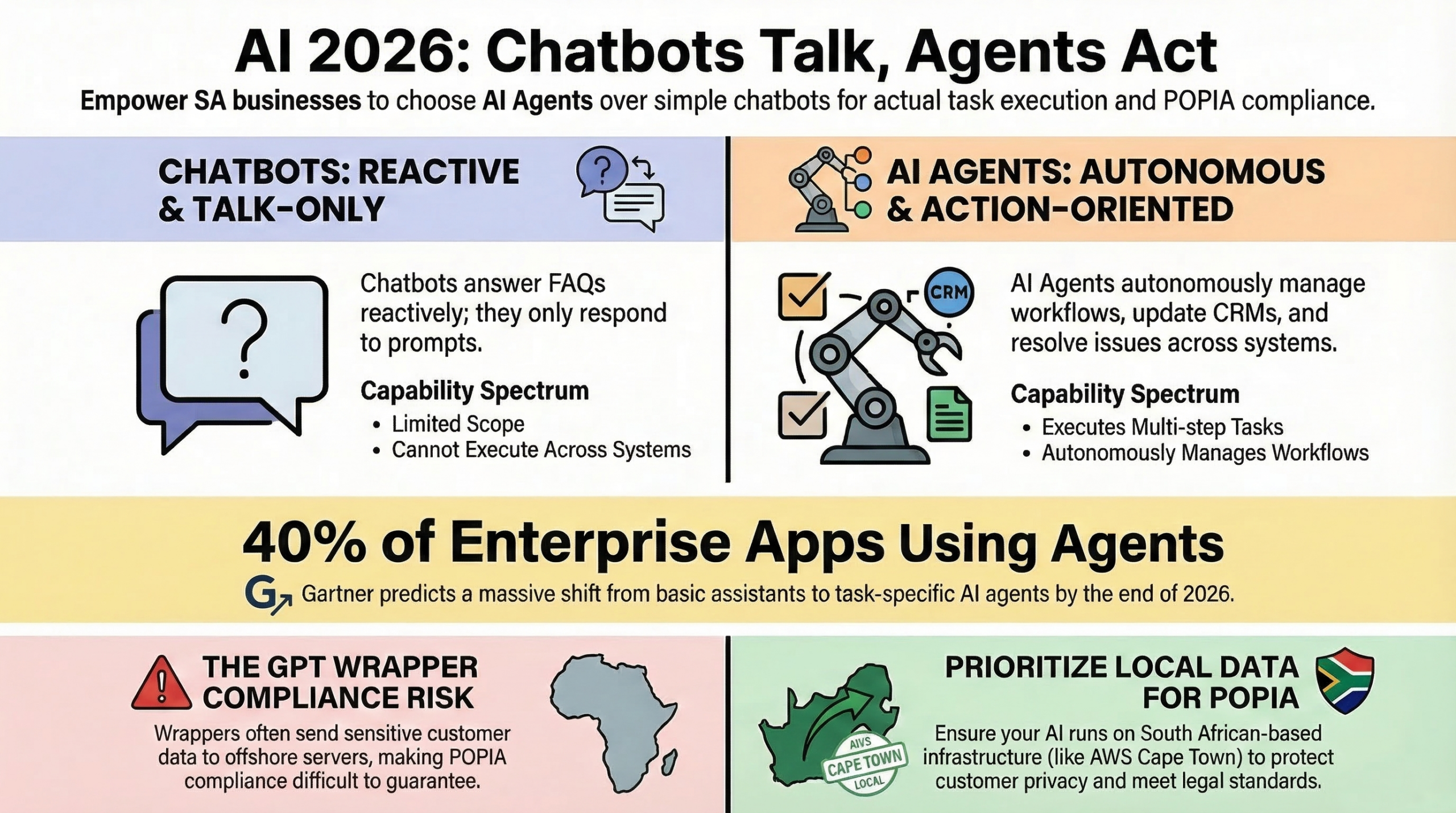
The data reflects this. A 2025 study by Zoho found that 92.6% of South African businesses have started their AI journey — but only 32.7% have achieved widespread or advanced implementation. Dell Technologies found that 94% of SA companies struggle to fully integrate AI into their operations, and 100% believe their teams lack the necessary AI skills.
This is not a technology problem. It is a clarity problem. And that’s what this article is here to fix.
A wrapper is a chat box. A custom agent is a digital employee with access to your filing cabinet.
Ramtin Lahooti, AI strategy advisor
Three Tools. One Overloaded Label.
Let’s break down the actual spectrum of AI tools being sold to businesses in 2026, starting with the simplest and moving to the most capable.
Basic Chatbot
A chatbot is a software application that responds to user messages based on predefined rules, decision trees, or a machine learning model trained on conversational data. When you ask it a question, it retrieves an answer from its knowledge base and responds. Then it waits for your next question.
Chatbots are reactive. They can’t initiate actions without a user prompt. They have no memory of previous conversations. They can’t update your CRM, check your stock, or trigger a follow-up sequence. Within their defined scope, they’re reliable and cost-effective. Across complex, multi-step tasks, they fall short.
Common use cases: answering FAQs, basic lead qualification, appointment booking (single-step), order status enquiries.
GPT Wrapper
A GPT wrapper is an application built on top of an existing AI model — typically OpenAI’s ChatGPT or a similar foundation model. It doesn’t create new AI; it adds an interface around someone else’s AI.
The appeal is fast deployment and a polished user experience. The risk is structural. Your business data often travels through third-party systems without your control. If the underlying model changes its pricing, terms, or capabilities, your tool breaks. And with over three million custom ChatGPT versions already in existence, there is effectively no competitive differentiation available.
Critically for South African businesses: POPIA compliance is difficult to guarantee when your customer data is processed by an offshore model on servers you don’t control.
AI Agent
An AI agent is a fundamentally different category. Where a chatbot responds and a GPT wrapper generates, an AI agent acts. It perceives its environment, reasons about the best course of action, executes multi-step tasks across multiple systems, and adapts based on outcomes — all with minimal human prompting.
Think of the difference this way: a chatbot is a straight road with one direction and one output. An AI agent is a city grid with intersections, routes, loops, and a navigation system figuring out the best path in real time.
Use cases for AI agents include: automated lead qualification that routes prospects to the right team member, WhatsApp conversation flows that personalise based on CRM history, HR self-service that processes leave requests across multiple backend systems, and post-sale support that resolves issues and updates records without human intervention.
At a glance:
- Chatbot: reactive, single-channel, scripted responses
- GPT Wrapper: fast to deploy, dependent on third-party model, limited data control
- AI Agent: autonomous, multi-system, action-oriented, persistent memory, POPIA-ready when built correctly
The Gap Between ‘Talking’ and ‘Doing’
The most important distinction in the entire spectrum is this: chatbots and GPT wrappers talk. AI agents do.
A chatbot can tell your customer that their delivery is estimated for Thursday. An AI agent can check live logistics data, send a personalised WhatsApp notification, update the CRM record, and flag the order for a follow-up call if the customer hasn’t confirmed receipt — all triggered automatically, without a human initiating any step.
Gartner has been emphatic about the direction of travel. By the end of 2026, 40% of enterprise applications will feature task-specific AI agents — up from less than 5% in 2024. Gartner’s Senior Director Analyst Anushree Verma describes the evolution clearly: “AI agents are progressing from basic assistants embedded in enterprise applications today to task-specific agents by 2026 and ultimately multi-agent ecosystems by 2029.”
For South African businesses, 2026 is precisely the window that Gartner describes as critical. CIOs and business owners who define their agentic AI strategy now will hold an advantage that compounds over the next two to three years.
What This Looks Like at S10U
Rather than speaking theoretically, let’s look at two examples from S10U’s own client portfolio.
Tenji — The Always-Online HR Assistant
Tenji is S10U’s HR automation product. On the surface it might look like a chatbot — employees ask questions and get answers. But Tenji operates across the full spectrum of HR self-service: processing leave requests, providing policy information, managing employee queries, and integrating with backend HR systems to take action, not just provide information.
IBM recently reported that 94% of typical HR questions are now answered by their AI-powered assistant, allowing HR professionals to focus on strategic activities. Tenji brings this same efficiency model to South African businesses, removing the administrative burden that consumes HR teams who should be focused on people, not paperwork.
As S10U describes it: “Tenji isn’t just a chatbot — it’s a time-saving, stress-reducing, data-loving HR ally.” That distinction matters.
S10U AI Studio on WhatsApp
S10U AI Studio powers AI-driven customer conversations on WhatsApp — South Africa’s dominant communication channel, used by 96% of internet users. For S10U clients in retail, automotive, insurance, and financial services, AI Studio does far more than answer questions.
It qualifies leads in real time, routes conversations intelligently, triggers personalised follow-up sequences based on CRM data, processes broadcast campaigns at scale, and hands off to human agents at precisely the right moment. All customer data is stored on South African-based AWS servers in the Cape Town region — an important POPIA compliance consideration.
This is not a chatbot. It is an AI agent built specifically for the South African market and communication context.
Three Questions to Find Your Answer
Not every business needs a full AI agent. Some use cases are perfectly served by a well-configured chatbot. The question is matching the right tool to the right problem. Here is the framework S10U uses when helping clients decide:
1. Does your business need AI to talk, or to do?
If you primarily need to answer FAQs, provide 24/7 availability, and handle simple enquiries on a single channel, a chatbot will serve you well. If you need to automate multi-step workflows, update systems, make decisions, or work across platforms, you need an AI agent.
2. Are your processes conversational, or operational?
Conversational needs — generating text, answering questions, summarising information — can be addressed by simpler tools. Operational needs — processing requests, updating records, coordinating across systems, triggering workflows — require an agent that can act autonomously with appropriate guardrails.
3. Where does your data live, and who controls it?
This is the question most businesses skip — and the one that matters most in a POPIA environment. When you use a GPT wrapper, your customer data typically travels through the underlying model provider’s servers, which may be located outside South Africa. 76% of South African companies surveyed by Dell Technologies express fears about exposing sensitive data to third-party AI tools. A custom-built AI solution on South African-based infrastructure eliminates this risk and makes POPIA compliance achievable by design.
The POPIA Reality Check
South Africa has no comprehensive AI legislation yet, but POPIA is fully applicable to any AI system that processes personal data — which is every customer-facing AI tool on the market.
POPIA requires lawful processing, data minimisation, informed consent, and the right for individuals to challenge automated decisions that affect them. It also requires that organisations conduct a Personal Information Impact Assessment before deploying AI models.
The practical implication: businesses that rush to deploy AI through off-the-shelf GPT wrappers without understanding where their data goes are creating compliance exposure they may not discover until they receive an Information Regulator inquiry.
S10U AI Studio was built with POPIA compliance as a design principle, not an afterthought. Data residency in South Africa, transparent processing, and configurable consent flows are built into the platform from day one.
Where SA Businesses Should Start in 2026
The SA AI market was valued at USD 809 million in 2024 and is projected to grow to nearly USD 6 billion by 2033 — a compound annual growth rate of 22.16%. Industry analysis describes 2025 as the year of AI awareness and 2026 as the year of AI execution. The businesses that start building intelligent automation now will be the ones setting the benchmark others chase.
But ‘start building’ doesn’t mean deploying the most complex solution first. It means getting clear on your business need, choosing the right tool for that need, and building on a foundation that can scale.
For most South African businesses, the right entry point is a well-designed AI agent on WhatsApp — the channel your customers already use, with the automation capability that goes beyond basic responses, on infrastructure that keeps your data where it belongs.
The confusion in the AI market is real. But the path through it is simpler than it looks — if you start with the right questions.

Not sure which type of AI is right for your business?
S10U offers a free AI needs assessment — a practical conversation about your business goals, current tools, and where intelligent automation will actually move the needle. No jargon. No hard sell. Just clarity.
- Author: Willie Swart | willie@s10u.co.za | Sideways10UP
Willie is a co-founder and strategic director at Sideways10UP. This article is based on original research compiled in the S10U AI Agents and Chatbots Research Brief (February 2026) and supplemented by Willie’s direct experience working with South African businesses on AI and automation implementation.
Published 25 February 2026. All statistics are sourced from research available by this date: Zoho/Arion 2025 SA adoption study, ASUS 2025 Future of SMBs, Dell Technologies 2025 SA AI report, Gartner 2025–2026 agentic AI forecasts. The SA AI market size data (USD 809M 2024, projected USD 5.99B by 2033) is from IMARC Group and Statista — both published before February 2026. POPIA regulatory context is accurate as of early 2026. The Gartner 40% AI agent adoption forecast for ‘end of 2026’ is forward-looking and appropriate for a February 2026 publication date. The article reads naturally as a February 2026 thought leadership piece — urgent and timely given the ‘year of AI execution’ framing consistent with industry consensus at that date.

Let us Bring your Ideas to Life in the Digital World.
No matter which services you choose, we are committed to delivering exceptional results that exceed your expectations. Our multidisciplinary team works closely together to ensure seamless collaboration and a unified vision for your digital product.